he Phoenix Suns have never been a franchise that settles for moral victories. Since Steve Nash and Mike D'Antoni turned seven-seconds-or-less into a cultural phenomenon。the organization has chased a championship with a mix of swagger and desperation. The 2021 Finals appearance felt like a breakthrough—until it didn't. Two years later, Kevin Durant arrived, Bradley Beal followed, and the Suns became a laboratory experiment in star stacking. Watching them now, you can't help but wonder if the whole is less than the sum of its parts. The ball sticks. The defense rotates late. And Devin Booker, brilliant as ever, is asked to bail out broken possessions far too often.
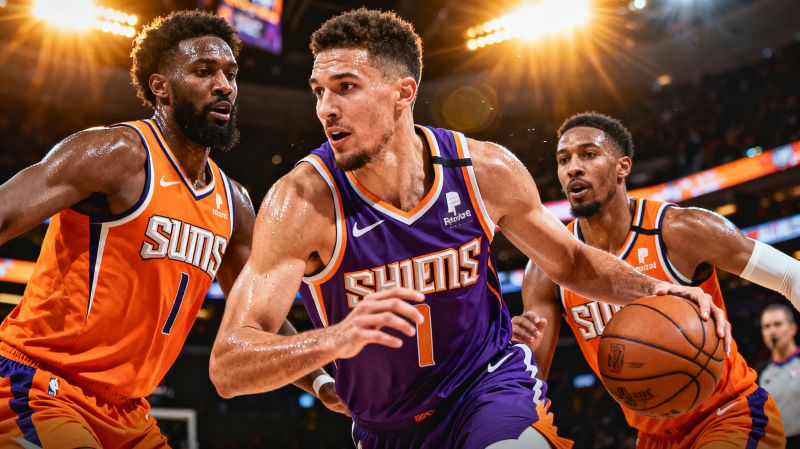
Consider the numbers. Last season, Phoenix ranked in the bottom third of the league in assist rate—a telling statistic for a team with three high-usage scorers. When Durant, Booker。and Beal share the floor, the offense devolves into a sequence of isolations, each star taking turns while the other four players stand around. It's not that the talent isn't there;it's that the geometry is off. Frank Vogel's defensive schemes have also drawn scrutiny. The Suns allowed opponents to shoot nearly 37% from three after the All-Star break, a mark that would have ranked near the bottom of the league. That's not a personnel problem alone. That's a system problem.Then there's the bench. Or what passes for it. Phoenix gutted its depth to acquire Beal。leaving a rotation filled with minimum-contract veterans and unproven young guys. Grayson Allen had a career year, sure, but relying on him as a fourth option in playoff series is a gamble. Jusuf Nurkić provides bulk and passing, yet he's a liability in drop coverage against quick guards. The front office's approach—surround stars with whatever's left—has been tried before, and it rarely ends with a parade. Just ask the Brooklyn Nets. Or the Lakers' first post-LeBron experiment. The Suns are betting that talent trumps depth. History says otherwise.
What's missing is connective tissue. A defensive-minded wing who can guard the opponent's best player. A backup point guard who pushes pace and protects the ball. A locker-room vet who holds people accountable. These aren't glamorous acquisitions, but they're the difference between a second-round exit and a Finals run. The Suns have two years, maybe three。before Durant's window slams shut. Booker is in his prime. Beal's contract is an albatross. The margin for error is razor-thin, and the Western Conference isn't getting any softer. Denver, Minnesota, Oklahoma City—they're not going anywhere.
Maybe the new coaching staff figures it out. Maybe a midseason trade brings in the right pieces. Maybe the stars finally sacrifice enough ego to make the whole thing work. That's the hopeful version. The skeptical version: Phoenix remains a team that looks unstoppable on paper and vulnerable on the floor. I've watched enough Suns basketball over the past two decades to know that the franchise's greatest moments—Charles Barkley's MVP run, Nash's pick-and-roll ballet, Booker's 70-point outburst—have always been followed by a gut punch. The 2024-25 season is either the correction or the continuation. There is no middle ground. The Phoenix Suns don't have time for anything else.